
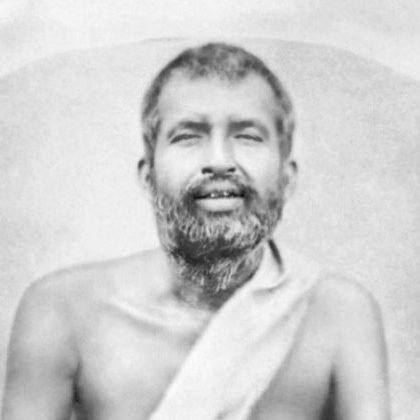
“You should remember that the heart of the devotee is the abode of God. He dwells, no doubt, in all beings, but He especially manifests Himself in the heart of the devotee. The heart of the devotee is the drawing room of God.”
His Universal Teaching Method
Sri Ramakrishna didn’t write any books; nor did he give any lectures and he didn’t create any definite rules or regulations to be followed. Instead, he expressed spiritual truths in simple language in his conversations with devotees. He articulated his own divine experiences through allegories, proverbs, anecdotes, and parables. Through this unique method, spiritual seekers would be able to understand the teachings and experience momentous transformation in their personalities. The teachings do not embrace any one particular philosophy or religion: they are universal, just like his personality.
Early Life
Sri Ramakrishna was born on February 18,1836 in the village of Kamarpukur about sixty miles northwest of Kolkata. His parents were poor but pious and virtuous. As a child, Gadadhar (his childhood name) was dearly loved by the villagers. From early days, he had strong disinclination towards formal education and worldly affairs. He was, however, a talented boy, and could sing and paint well. He was fond of serving holy men and listening to their discourses. He was oftentimes found to be absorbed in spiritual moods. At the age of six, he experienced the first ecstasy while watching a flight of white cranes moving against the background of black clouds. This tendency to enter into ecstasy intensified with age. His father’s death when he was seven years old, served only to deepen his introspection and increase his detachment from the world.
As a Temple Priest
When he was sixteen, his brother died and Ramakrishna was appointed to take his place as priest of the Kali Temple at Dakshineswar. There, he developed an intense devotion to Mother Kali and spent hours in loving adoration of her image, forgetting the rituals of priestly duties. His intense longing culminated into the vision of Mother Kali as boundless effulgence, engulfing everything around him.
Intense Spiritual Practices
Sri Ramakrishna’s God-intoxicated state alarmed his relatives and so they arranged the marriage to Sarada, a girl from the neighboring village of Jayrambati. Unaffected by the marriage, Sri Ramakrishna plunged into even more intense spiritual practices. Impelled by a strong inner urge to experience the different aspects of God, he followed all the various paths described in the Hindu scriptures. With the help of a series of Gurus, he realized God through each of the paths. The first teacher to appear for him at Dakshineswar in 1861, was a remarkable woman known as Bhairavi Brahmani who was an advanced spiritual adept, well versed in scriptures. With her help, Sri Ramakrishna practiced difficult disciplines of the Tantrik path, and attained success in all of them. Three years later came a wandering monk by the name of Totapuri, under whose guidance Sri Ramakrishna attained Nirvikalpa Samadhi, the highest spiritual experience mentioned in the Hindu scriptures. He remained in that state of non-dual existence for six months without the least awareness of even his own body.
Following Other Faiths
With his unquenchable thirst for God, Sri Ramakrishna went beyond the limitation of one religion. Born into Hinduism, he also studied and followed the paths of Islam and Christianity, and attained the highest realization through each of them in a short span of time. He looked upon Jesus and Buddha as incarnations of God, and venerated the ten Sikh Gurus. He expressed the quintessence of his twelve-year-long spiritual realizations in a simple dictum: Yato mat, tato path “As many faiths, so many paths.” He now habitually lived in an exalted state of consciousness in which he saw God in all beings.
Worshipping His Wife
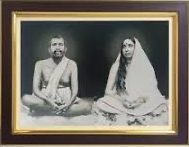
In 1872, his wife Sarada, now nineteen years old, came from the village to meet him. He taught her how to attend to household duties and at the same time to lead an intensely spiritual life. One night he worshipped her as the Divine Mother in his room at the Dakshineswar temple. Although Sarada continued to stay with him, their marital relationship was purely spiritual. It should be mentioned here that Sri Ramakrishna had been ordained a Sannyasin (Hindu monk), and he observed the basic vows of a monk to perfection. But outwardly he lived like a lay man, humble, loving and with childlike simplicity.
Coming of the Devotees
A band of youths, who came to Sri Ramakrishna drawn by the magnetism of his divine personality, and got the garb of renunciation from him, is known to us as his monastic disciples. There were a total of sixteen monastic disciples of Sri Ramakrishna. They were: Swami Vivekananda, Swami Brahmananda, Swami Shivananda, Swami Akhandananda, Swami Vijnanananda, Swami Premananda, Swami Turiyananda, Swami Ramakrishnananda, Swami Saradananda, Swami Niranjanananda, Swami Advaitananda, Swami Adbhutananda, Swami Subodhananda, Swami Trigunatitananda, Swami Abhedananda and Swami Yogananda.
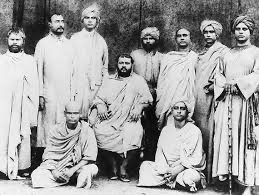
Sri Ramakrishna’s name as an illumined saint began to spread. An assembly of scholars declared him not to be an ordinary human being, but the Avatar of the Modern Age. As bees swarm around a fully blossomed flower, devotees now started coming to Sri Ramakrishna. He divided them into two categories. The first one consisted of householders. He taught them how to realize God while living in the world and discharging their family duties. The other category was a band of educated youths, mostly from the middle class families of Bengal, whom he trained to become monks and to be the torchbearers of his message to mankind. The foremost among them was Narendranath, who years later, as Swami Vivekananda, carried the universal message of Vedanta to different parts of the world, revitalized Hinduism, and awakened the soul of India. His conversations attracted the cultural elite of Bengal. These conversations were noted down by his disciple Mahendranath Gupta who published them in the form of a book, The Gospel of Sri Ramakrishna. It was released in 1942 and it continues to be popular to this day on account of its universal appeal and relevance.
Last Days
The intensity of his spiritual life and untiring spiritual ministry to the endless stream of seekers took a toll on Sri Ramakrishna’s health. He developed throat cancer in 1885, and was moved to a spacious suburban villa where his young disciples nursed him day and night. He instilled in them a love for one another, and thus laid the foundation for the future monastic brotherhood known as Ramakrishna Math. On August 16, 1886, Sri Ramakrishna gave up his physical body, uttering the name of the Divine Mother, and passed into Eternity.
His Teachings Briefly Stated
There are four stages in spiritual life: commitment to moral principles, renunciation and dispassion, love towards God, and finally, the experience of God’s presence everywhere.
The goal of human life is the realization of the Ultimate Reality which alone can give supreme fulfilment and everlasting peace. This is the essence of all religions.
The Ultimate Reality is one; but it is personal as well as impersonal, and is indicated by different names (such as God, Ishvar, etc) in different religions.
The Ultimate Reality can be realized through various paths taught in world religions. All religions are true in so far as they lead to the same ultimate Goal.
Through spiritual practices one can overcome negative tendencies, and divine grace can redeem even the worst sinner. Therefore one should not brood over the past mistakes, but should develop a positive outlook on life by depending on God.
Women are special manifestations of the Divine Mother of the Universe, and so are to be treated with respect.
Since God dwells in all people, helping the needy should be done not out of compassion (which is an attitude of condescension) but as humble service to God.
Life is an expression of the spontaneous creativity (Lila) of God. Pleasure and pain, success and failure, etc are to be borne with patience, and one should resign oneself to God’s will under all circumstances.
Contributions to World Culture
Sri Ramakrishna established the possibility of having direct experience of transcendent Reality. His life has enabled thousands of people to gain or regain faith in God and in the eternal truths of religion.
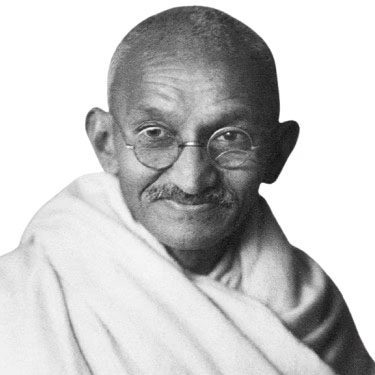
“His [Sri Ramakrishna's] life enables us to see God face to face. No one can read the story of his life without being convinced that God alone is real and that all else is an illusion.”
Harmony of Religions
Sri Ramakrishna is well known all over the world as the Prophet of Harmony of Religions. He didn’t say that all religions are the same. He recognized differences among religions but showed that, in spite of these differences, all religions lead to the same ultimate goal, and hence they are all valid and true. The uniqueness of Sri Ramakrishna’s view is that it was based, not on speculation, but on direct experience gained through actual practice. Since conflicts among religions and the rise of religious fundamentalism are a major threat to the peace, prosperity and progress of humanity, Sri Ramakrishna’s doctrine of harmony of religions has immense importance in the modern world.
Serving God in Everyone
We all try to experience the presence of God within our being through prayer, meditation, and repetition of God’s name. At the same time, we should strive our best to experience the presence of God in all human beings.
When we develop spiritual insight into seeing every human being as God, a real type of service becomes possible. It no longer becomes service to another human being; it transforms into the worship of God. Through this transformation in attitude towards others, every secular help or service will have a spiritual dimension. Then, through the touch of the Divine, all our actions will become sacred and our minds will be purified through constantly engaging in service activities performed as worship of God.
Whatever we do with a worshipful attitude, in due course, will take the form of worship of God and become a part of spiritual discipline. What is considered ‘work’ in the beginning, will become service. Then service will become worship and worship will evolve into contemplation. Through constant contemplation, one will realise God. This is how one can find fulfillment in one’s life.
Sayings of Sri Ramakrishna
“Do not let worldly thoughts and anxieties disturb your mind. Do everything that is necessary in the proper time, and let your mind be always fixed on God.”
“The breeze of His grace is blowing day and night over your head. Unfurl the sails of your boat (mind), if you want to make rapid progress through the ocean of life.”
“Pure knowledge and pure love are one and the same thing. Both lead the aspirants to the same goal. The path of love is much easier.”
“One should constantly repeat the name of God. The name of God is highly effective in the Kaliyuga. The practice of yoga is not possible in this age, for the life of a man depends on food. Clap your hands while repeating God’s name, and the birds of your sins will fly away.”
Recommended for further reading:
- Mahendranath Gupta, The Gospel of Sri Ramakrishna, tr. Swami Nikhilananda
- Swami Saradananda, Sri Ramakrishna: The Great Master, tr. Swami Jagadananda,
- The Life of Sri Ramakrishna, Published by Advaita Ashrama
- Ramakrishna and His Disciples, by Christopher Isherwood