
Excerpts from Traveling the Path of Love: Sayings of Sufi Masters by Llewellyn Vaughan-Lee, contemporary Sufi Master:
The mystical path is the soul’s journey from separation back to union. On this homeward journey we are seeking our own innermost essence, the pearl of great price that lies hidden within the heart.
Sufism is a mystical path of love. It emerged in the Muslim world in the eighth century in small groups of seekers who were known as “Wayfarers on the Mystical Path.” In their deep passion and longing for God they realized Truth as “The Beloved,” and therefore also became known as “The Lovers of God.” Later they were called Sufis, possibly referring to their white woolen garments (Sûf ), or as an indication of their purity of heart (Safâ’).
These small groups gathered around spiritual teachers and, in time, matured into fraternities and orders, with each order bearing the name of its initiator.The essence of the Sufi path is the particular tradition passed down from teacher to disciple in an uninter-rupted chain of transmission.
Each Sufi order and teacher has certain practices and principles to help the wayfarer on the journey, to keep the fire of longing burning within the heart and the attention focused on the goal. The sayings and writings about the path help the wayfarer to develop the right attitude and qualities, and also to understand inner happenings that are often bewildering and confusing.The ways of love are very different from those of the mind.
The Sufi path has as its goal the state of union with God. For each traveller the journey to this goal is unique; it is the journey “of the alone to the Alone.” Yet there are also stages which all seekers pass through, trials, processes of purification and transformation. It is these stages that the Sufi masters, or sheikhs, have attempted to describe. As guides they have mapped out the path of the heart and the mystical states that are experienced along the way.
The teachings and writings of the Sufis describe the soul’s journey from separation to union with God. With the passion and depth of feeling that belong to lovers they outline the stages of this journey and give advice to other travellers. Sufi literature offers us the richest and most detailed understanding of the relationship of lover and Beloved, a relationship that is at the core of every
mystical path.
Drawing on their own experiences, the Sufi masters describe the inner workings of the path of love. They tell how longing for God burns away our impurities.
Sufism is defined as “truth with-out form,” and the Sufi aspires to become “featureless and formless,” to be so lost in God that only He remains. But there are certain qualities that belong to these travellers on the path of love:
What is a Sufi?
“The Sufi is he whose thought keeps pace with his foot, i.e., he is entirely present: his soul is where his body is, and his body where his soul is, and his soul where his foot is, and his foot where his soul is. This is the sign of presence without absence. Others say on the contrary: ‛He is absent from himself but present with God.’ It is not so: he is present with himself and present with God.”
“A Sufi is to give up all worries and there is no worse worry than yourself. When you are occupied with self you are separated from God. The way to God is but one step: the step out of yourself.”
“To be a Sufi means to abide continuously with God and to be at peace with men.”
The Whirling Dervish and the Sema
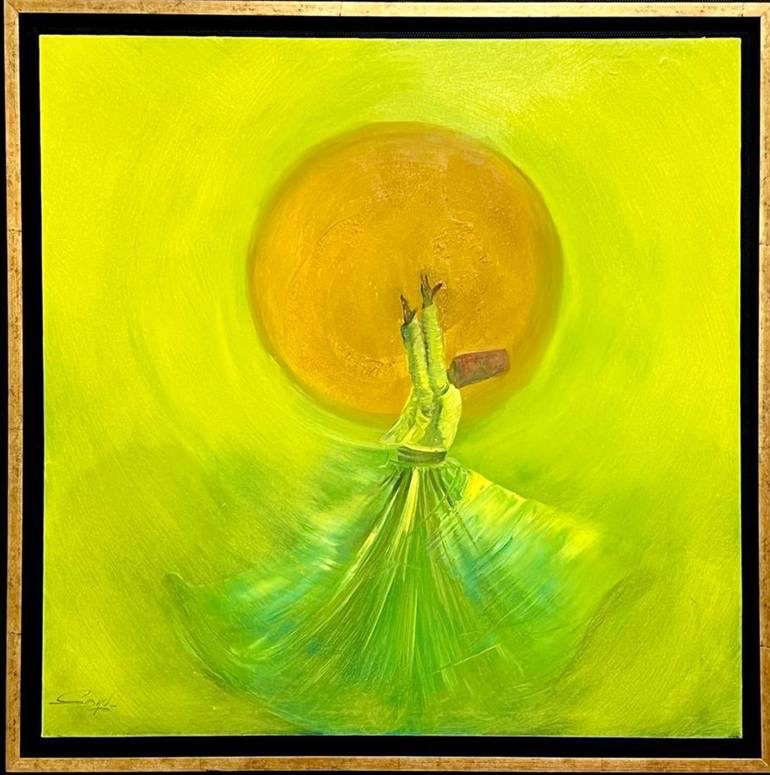
In the Light
This painting by Zoha Quasim depicts a Sufi dervish. A dervish is a member of a Sufi Muslim ascetic brotherhood (tariqa) dedicated to a life of poverty, humility, and spiritual devotion. Known for seeking direct experience of God, some orders, like the Mevlevi "whirling dervishes," practice a meditative dance called Sema, where they spin to abandon their ego and attain spiritual perfection.
The Sema represents the essence of the Sufi journey: the tan-colored hat symbolizes the ego’s tombstone, and the wide, white skirt is its shroud. The removal of the black cloak is shedding the ego’s selfishness and becoming reborn to truth. While whirling, the right hand is open upwards towards the sky, symbolizing receiving of God’s beneficence, while the left hand is pointed downwards towards earth, symbolizing the transference of that beneficence to humanity. Whirling itself is symbolic of the heart’s revolution around the divine, and embracing all of humanity with love.
Additional Sufism Resources
- Traveling the path of Love: Sayings of Sufi Masters by Llewellyn Vaughan-Lee
https://irp.cdn-website.com/e401e78b/files/uploaded/sayings_sufi_masters.pdf- - The Pluralism Project Harvard University
https://pluralism.org/sufism-seeking-god