
October 5, 1823 – January 30, 1874
"If you want the golden key to unlock the heavens, be kind to all that lives."
Saint Ramalinga Swamigal
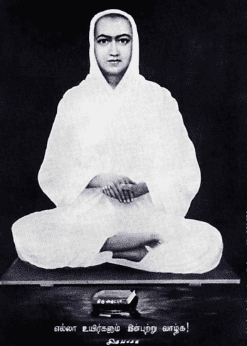
Ramalinga Swamigal, one of the most famous South Indian Tamil Saints, is commonly known in India and across the world as Vallalar, or Ramalinga Adigal. Adigal is a title that means venerable or respected. He is also one of the greatest Tamil poets of the19th century, belonging to a line of Tamil saints known as ‘gnana siddhars’, which means, perfected beings of higher wisdom.
During his lifetime, the poems and songs of Saint Ramalinga swelled into thousands, and all have been compiled in two volumes as ‘Thiru Arutpa’. A poem from this collection, written in very early childhood is:
On the Veranda where I slept, tossing
I felt You stay my fall half-way
And lay me safely on the ground
O Hands of Love…..
Sri Gurudev often used Saint Ramalinga as an example of total faith in God. He said, “ Let us be like Saint Ramalinga who beautifully said: "Lord, You are feeding me, I am getting fed. You are making me sleep, I sleep. You are making me dance, I dance. You are showing me, I am seeing. You are making me happy, I am happy. Not only me, the entire cosmos, all the species in the cosmos dance to Your tune. When I realize that, why should I be afraid of anything, because none of that is done by me. It is all done by You.”
Many of his so-called followers were more interested in the miracles that he performed, than in the Teachings. He really became fed up with all that and eventually said, "I opened my shop. Nobody is buying what I have to offer. They are all buying miracles, that's all. Nobody seems to be interested in the real thing. You are not yet ready. I will close my shop and go." Then, except for his true disciples, he hid his saintly identity. He made himself look like an ordinary person and even started to carry a large bunch of keys with him. Followers would say, “You don't even own anything with a lock, Why are you carrying these keys?” His reply: let other people think that I am a businessman!
Ramalinga advocated the concept of worshipping the flame of a lighted lamp as a symbol of the Eternal Power. He built a Temple to the Light in Vadalur, named Sathya Gnana Sabhai (Hall of True Knowledge) which is not a traditional temple. It is a secular space for spiritual learning. He did not build traditional Hindu temples. Unlike a traditional Hindu temple, the Sathya Gnana Sabhai does not have idols for worship, and no offerings or blessings are given in the traditional sense. It was created as a space for people to worship the "Arutperunjothi" (the light of divine grace) and was intended to be open to everyone. He believed that it is insane to fight in the name of various paths. Ultimately there is one light, the Cosmic Light. It passes through a prism and gives room for various colors. This idea is identical to the Teaching of Integral Yoga: Truth is One, Paths are Many.
Ramalinga taught that ultimate reality or ultimate truth is unchanging, universally applicable, and beyond individual perceptions or interpretations. Such an understanding leads to the realization of this ultimate truth, free from the limitations of relative or conventional beliefs. He lived this realization and in so doing, was an inspiration for his followers. He taught that the prime aspects of human life should be love, connected with charity and divine practice, leading to pure knowledge.
Ramalingam was born to Ramayya Pillai and Chinnammai in the small village of Marudhur in Southern India. One day, when Ramayya Pillai was away from home, a saffron-clad saint came to their house. Pleased immensely with the courtesy given to him, the saint blessed Chinnammai with sacred ash and uttered the following words, ‘You will beget a son, who will be able to deliver the art of deathlessness, which will be a boon to the entire world.‘ Soon Ramalingam was born.
Unfortunately, when Ramalinga was only six months old, his father passed away. After some years, when the elder brother had grown up, he moved the family to Chennai where he could find work. Ramalingam was given an elementary education from age five to nine by his elder brother Sabapathy Pillai. But the young boy showed little interest in this formal education. Instead, he used to go to the nearby temple of Lord Muruga and prayed to Lord Muruga to teach him the art of meditation.
Often, instead of studying, he would light a lamp, and place a mirror in front of it within the room. Sitting before it, he concentrated on a specific spot in the mirror where the brilliance of the lamp fell and he became lost in deep meditation. During these times, Ramalinga was given the glorious vision of Lord Muruga.
Filled with divine ecstasy, his joy overflowed in the form of songs in praise of the Lord. Through Divine Grace, Ramalinga was blessed with the knowledge of all arts and skills, and gifted with the ability and talent to perform miracles and Siddhis (wondrous deeds). He continued to meditate in front of the mirror from 1832 to 1835 with Lord Muruga appearing through the mirror and teaching him the path of Wisdom.
Ramalinga faced hardship and opposition. He was described as having a look of constant sorrow on his face. During the latter part of his life, he often expressed his bitter sorrow for the sad state of things. It is a well-known historical fact that the lives of Saints can at times be very hard, often because they meet opposition from religious orthodoxy. Ramalingam’s life was no exception, and the difficulties weighed heavily on him. His poetry and character were criticized and debased and he was maliciously sued in court.
Over time, Ramalingam’s opponents developed a large following and even tried to poison him with arsenic. One night, a large crowd of agitators came to his house in Vadalur and tried to force open the door. Ramalinga wept, holding the bolt of the door, and prayed to Lord Siva to rescue him. His suffering and agony are expressed by him in this poem:
Oh Lord! I cannot tolerate the words of abuse any longer. I am unable to take my food and go to sleep. If you safeguard me, I will remain in this world; otherwise, I will die. No sooner, I perceived a great Light and, happiness prevailed upon me.The sweet nectar was tasted by me as soon as the great Grand Light became visible.
Marital life did not distract Ramalinga from his religious duty. He was a relentless critic of practices based on birth, class, status, or privilege. He had no regard for the ancient scriptures such as ‘Puranas,’ ‘Vedas,’ and ‘Agamas.’ He worshiped God as Light (Jyothi) and was a man of utmost love and compassion for all living creatures. He would weep at the sight of even a withering crop. He firmly believed in anna dana, a free offering of food to the needy.
In 1867, he established a free food facility named ‘The Sathya Dharma Salai’ in Vadalur. There, all people are served free food without any caste distinctions. This free facility continues its service today.
It can be seen from the history of his life that in his later years, his physical body had become tenuous and translucent. Disciples have recorded that it cast no distinct shadow. It has been reported that several attempts were made to photograph him, but since light passed through his body, no clear image could be obtained. What could be seen were only his clothing and a very misty vision of his face and limbs. His eventual dematerialisation was but a few steps away.
Towards the end of his life, he let his hair grow long and his garments consisted of only two pieces of white cloth.His habits were excessively abstemious. He was known to hardly ever take any rest. A strict vegetarian, he ate but once in two or three days and was then satisfied with a few mouthfuls of rice. But when fasting for two or three months at a time, he literally ate nothing, living merely on warm water with a bit of sugar dissolved in it.
One of the more famous of his miracles is how he did not die like an ordinary person. He simply walked into a room and dematerialized; he dissolved his body and disappeared.
These were his final words, before the disappearance:
“If you want the Grace of God, sit before the lamp because God is in the form of Light now. Be kind to all living beings. I will not be visible for 150 years. (1874 + 150 = 2024) I will be in this world as well as in the Universe. Afterward, when the Lord of Great Gracious Light comes, I will do miracles with the form of a human body.”
Throughout his life, from a very early age, Ramalinga Swamigal knew his purpose. He freely told everyone that:
“God has sent me in this yuga, charged with His Divine Grace. It is for me to correct the people of the world whose hearts are full of darkness, and to gain admission for them into the Sanmarga Sangam, the Society for Pure Truth in Universal Self-hood, so that they can experience heaven here and now.”
More detailed information on his miracles and Teachings are found in these resources: